The animated podcast · Season 1: Einstein & Curie
Two geniuses sit down at the mic and tell their own story, with real letters, real dates and a fact-check on every claim.
Episode 1 · Brussels, 1911
Einstein and Marie Curie record a podcast "today" and look back on the first Solvay Conference: physics cracking open, the most famous photo in science and, at the very same time, the Paris newspapers turning on Marie.
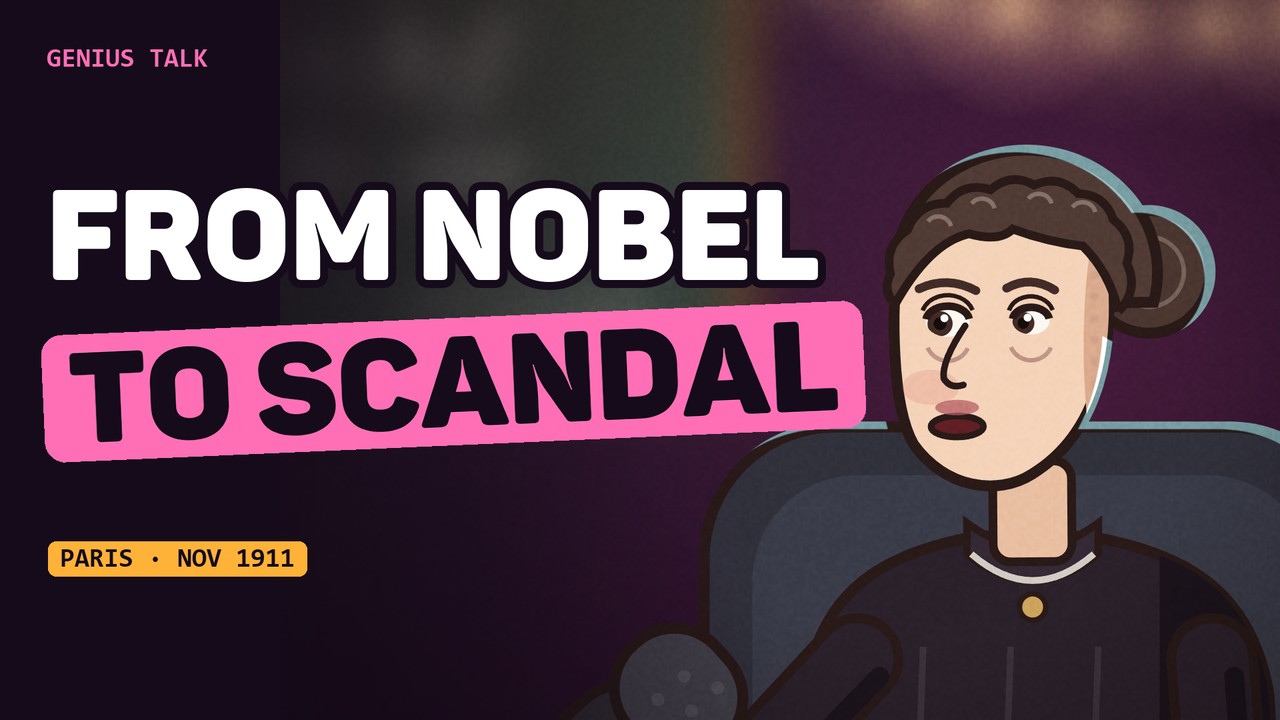 PREMIERES NOV 7 · 12 PM ET
Episode 2 · The Letter
Marie reads aloud the letter Einstein sent her from Prague on November 23, 1911. Then comes Langevin's pistol duel, a Nobel laureate asking her not to come to Stockholm, her answer, and the chemistry behind her second Nobel: how you isolate radium.
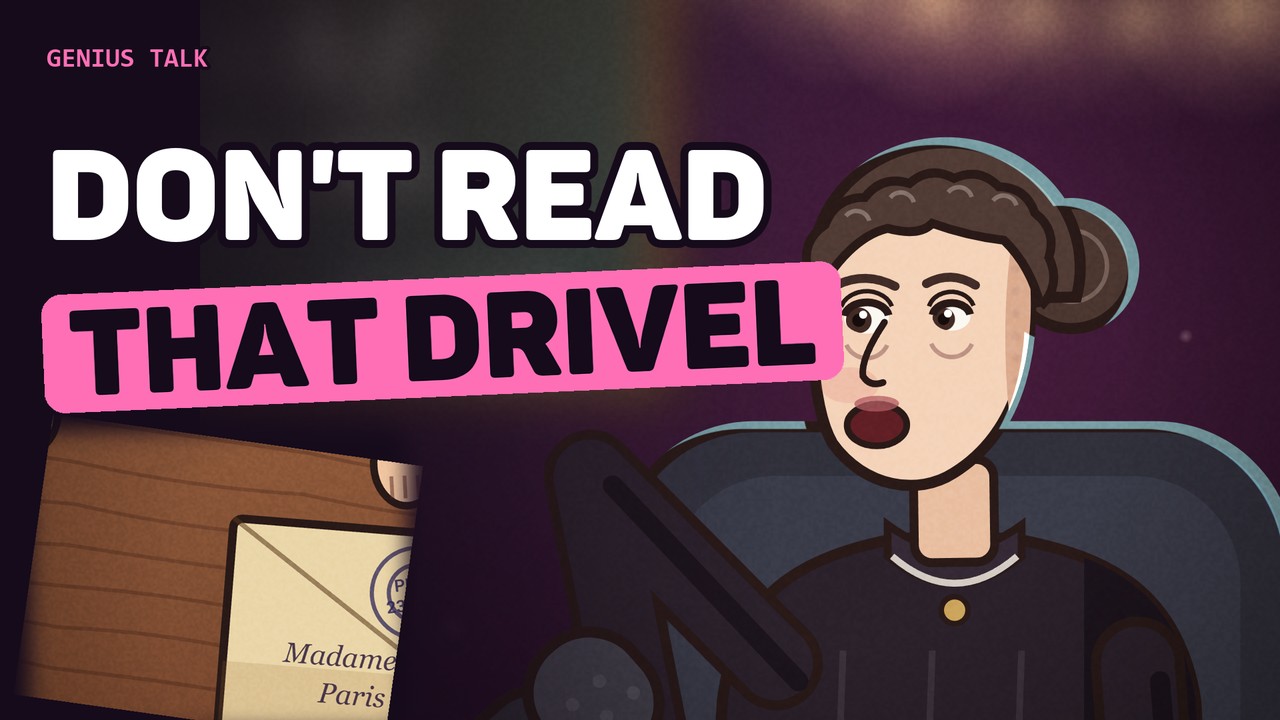 PREMIERES NOV 23 · 12 PM ET
Prague, November 23, 1911
Highly esteemed Madame Curie,
Don't laugh at me for writing to you without anything sensible to say. But I am so furious at the vile way the public dares to busy itself with you that I simply have to let it out. I am sure you despise this rabble, both when it pretends to adore you and when it uses you to feed its hunger for scandal.
I must tell you how much I have come to admire your mind, your energy and your honesty. I count myself lucky to have met you in Brussels. Anyone who is not one of these reptiles is glad that we have among us people like you and Langevin, real people, in whose company one feels privileged.
If the rabble keeps busying itself with you, simply don't read that drivel. Leave it to the reptile it was cooked up for.
A. Einstein
Our own abridged translation from the German original in The Collected Papers of Albert Einstein, vol. 8. For a full published translation, see B. Schwarzschild, Physics Today (2005).The wildest autumn of 1911
The episodes squeeze these dates into one conversation. Here is the real order, with each source listed at the bottom of the page.
Who's who
Twenty-four people. Three already had a Nobel that November; six more would win one later. Marie sits at the table next to Poincaré; Einstein is second from the right, standing next to Paul Langevin.
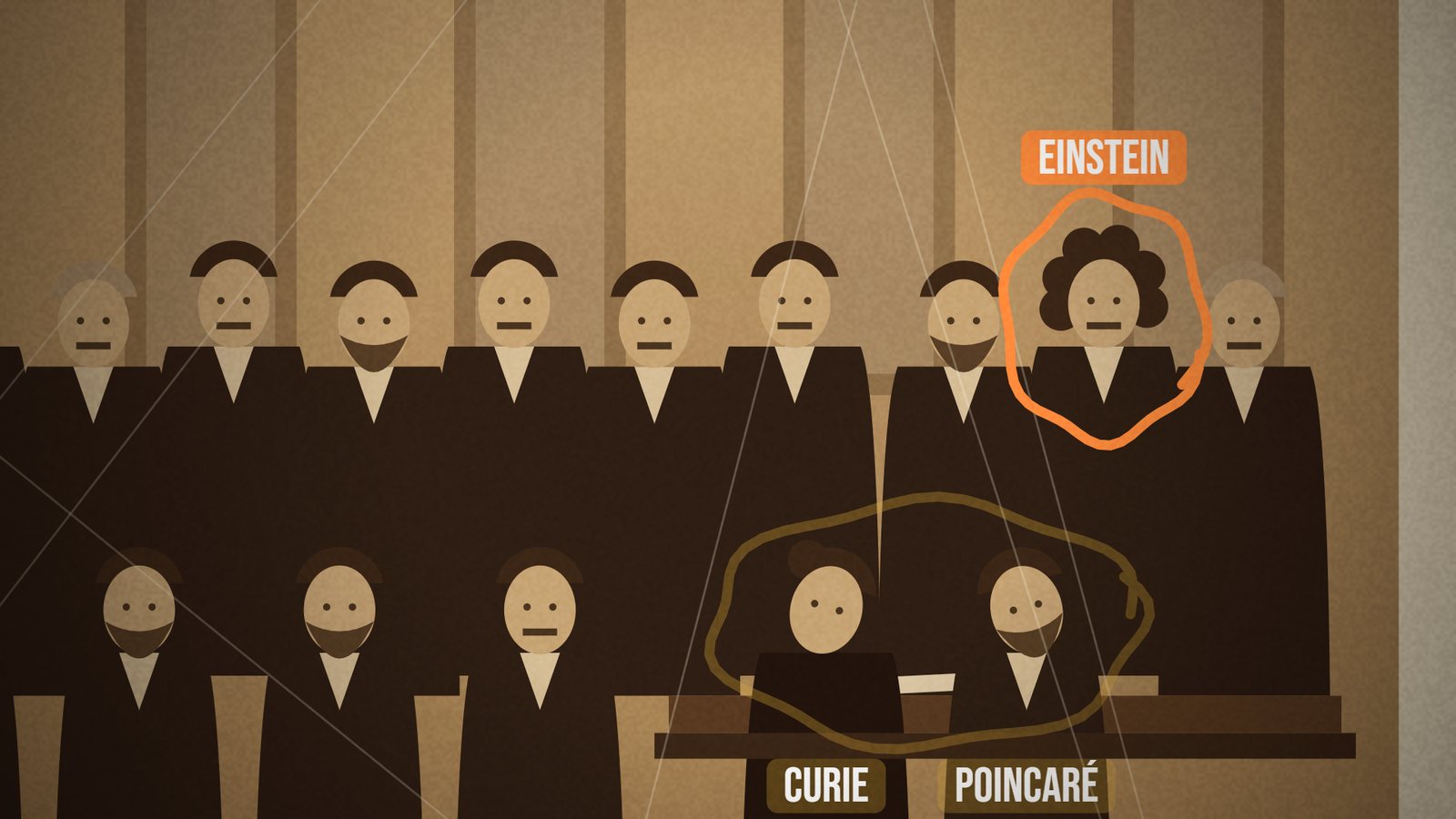
Look at Solvay. He wasn't in the room when the photo was taken: his portrait was pasted in afterwards for the official version. That's why his head looks too big. (Straumann, 2011)
Play
Twelve claims about autumn 1911. Some are in the episodes; others only in the sources.
Correct 0 of 0 answered
How the script was checked
Before release, every fact was checked against a paper or a book. In Episode 1, two checks changed the video; in Episode 2, three changed the script.
| Claim | Result | Source |
|---|---|---|
| Ep. 1 · Brussels, 1911 | ||
| Einstein gave the last report, on specific heats | confirmed | Straumann; Rocci & Lambert; Sánchez Ron |
| Einstein called the conference a "witches' sabbath" | corrected | He wrote it before the conference (letter of Oct 21). The video now says so. Sánchez Ron; Lambert |
| The idea came from Nernst; Solvay wanted to present his own theory | confirmed | Straumann; Rocci & Lambert; Sánchez Ron |
| Marie seated next to Poincaré; Einstein standing next to Langevin | confirmed | photo captions in Straumann and Sánchez Ron |
| Pierre Curie and Laborde measured the heat of radium in 1903 | confirmed | Comptes rendus 136, 1903 (about 100 calories per hour per gram) |
| Rutherford proposed the nucleus in 1911 | confirmed | Phil. Mag. 21, 669, May 1911 |
| The Le Journal headline ran on Nov 4, 1911 | confirmed | Constructing a Nobel Prize |
| A crowd and a stone at Marie's house; refuge with Camille Marbo | corrected | It happened after Nov 23, after the Nobel news. The video changed the order. Camille Marbo is the pen name of Marguerite Borel. Constructing a Nobel Prize |
| Marie's statement to Le Temps | confirmed | published Nov 8, 1911 Constructing a Nobel Prize |
| Order: headline, Nobel telegram, published letters | confirmed | Nov 4, Nov 7, Nov 23 Constructing a Nobel Prize |
| Ep. 2 · The Letter | ||
| Einstein's letter to Marie, Nov 23, 1911 | confirmed | Collected Papers, vol. 8; Physics Today (2005) Constructing a Nobel Prize |
| Einstein wrote after reading the letters in L'Œuvre | corrected | Same day, but he had been reacting to the papers since Nov 4; in Prague he hadn't seen the magazine. The episode says so. |
| The letter to Zangger: "not attractive enough to be a danger" | confirmed | Nov 7, 1911 Sánchez Ron (CPAE 5) |
| Duel of Nov 25: one bullet at 25 m, nobody fired | confirmed | Constructing a Nobel Prize (Le Journal, Nov 26, 1911; Marbo) |
| Painlevé, Langevin's second, later prime minister | confirmed | Sep–Nov 1917 and Apr–Nov 1925 Britannica |
| Arrhenius asked Marie not to come; she replied on Dec 5 | confirmed | Constructing a Nobel Prize (Karin Blanc, Bibnum, 2018) |
| The chemistry of isolation: decigrams per ton, thousands of crystallizations, atomic weights from 138 to 226.45, metallic radium in 1910 | corrected | We dropped the date "atomic weight in 1902", which the lecture doesn't give. Nobel lecture, Dec 11, 1911 |
| Marie proposed in 1900 that the atom transforms | corrected | "Two years before Rutherford", not "before anyone": Elster and Geitel had a similar idea in 1899. Hurwic (1979) |
| Hertha Ayrton hid Marie and her daughters in summer 1912 | confirmed | two months, in a house on the English coast Bruton (2018) |
| Irène won the 1935 Nobel with Frédéric Joliot | confirmed | Irène Joliot-Curie's Nobel lecture, Dec 12, 1935 |
Still without a source: the line "I heard about it at the hotel" (Ep. 1). Still to check in the German original: the exact word of praise in the Nov 23 letter ("energy" or "creativity"). The dialogue is recreated; the facts behind it are not.
How it's made
Genius Talk imagines two scientists who have read their own biographies and sit down to set the record straight. The story is real; the conversation is not.
Letters, newspapers of 1911 and peer-reviewed history of science. Each fact is listed above with its source.
The characters speak in a modern podcast voice. When they quote a letter, the words come from the letter, in our own translation.
The voices are generated with AI and designed for the show. They don't imitate any recording of Einstein or Curie. Music, sound and drawings are original.
Anything invented for a laugh is flagged in the "Fact or fiction" segment at the end of every episode.
Teacher kit
Each episode fits at the start of a lesson, and the chapters let you play just one part. Free to use in class; please link back to this page.
Physics · high school
Ep. 1, chapter 2:22. Why did classical physics predict infinite energy in the ultraviolet? What changes when energy comes only in packets of E = hf?
Chemistry · radioactivity
One gram of radium gives off about 100 calories per hour with no fuel at all. Where does that energy come from?
History · social studies
Ep. 1, chapter 5:38. The papers attacked Marie for being foreign, Polish and a woman. The same year, Einstein was treated as a prodigy. Why?
Chemistry · separating mixtures
Ep. 2, chapter 6:49. Radium and barium are in the same group; fractional crystallization, repeated thousands of times, pulls them apart. Why does an atomic weight climbing from 138 to 226 prove it's a new element?
English · ethics
Ep. 2. Compare Einstein's letter (above) with Marie's reply to Arrhenius: what does each one defend? Write your own message of support to someone attacked unfairly.
Any subject
Give each group three claims from Fact or fiction and ask them to find a source for each. Then compare with the fact-check table.
The season
Episode 2 premieres on November 23, 2026, exactly 115 years after Einstein wrote his letter to Marie.
Working titles; they may change.
Go further